
No products in the cart.








History of the Printing Press (1440-2026)
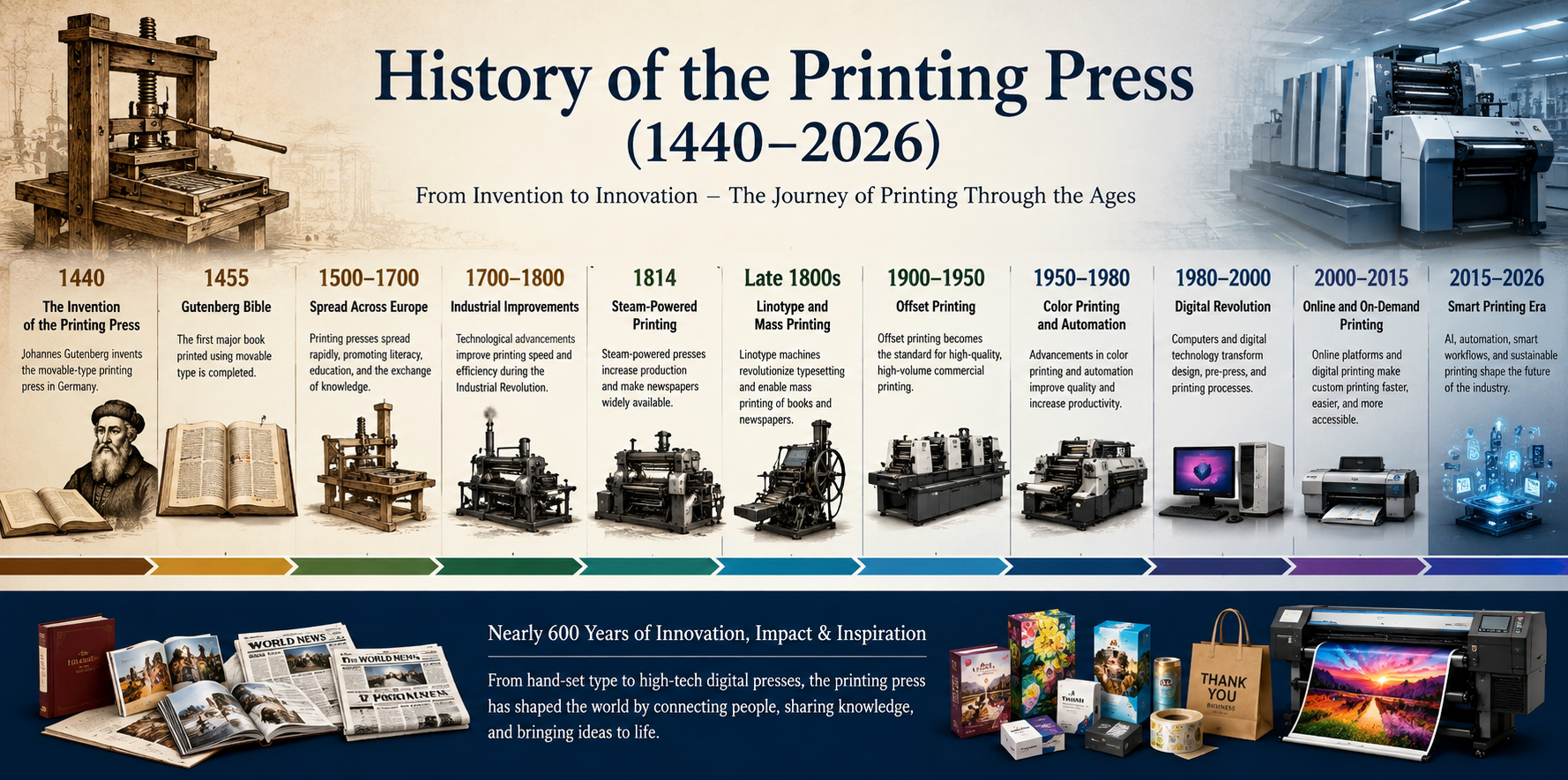
The history of the printing press spans more than five centuries and is one of the most important developments in human communication. It transformed the way knowledge, education, religion, science, and business information were shared across the world.
Early Printing Before the Press
Before the invention of the printing press, books and documents were copied by hand. This process was slow, expensive, and limited access to knowledge. In ancient China, woodblock printing was used as early as the 7th century, allowing texts and images to be reproduced more efficiently.
1440 – The Invention of the Printing Press
Around 1440, Johannes Gutenberg developed the movable-type printing press in Germany. His invention allowed individual metal letters to be arranged and reused for printing multiple pages. This dramatically increased printing speed and reduced costs.
1455 – Gutenberg Bible
One of the first major books printed using Gutenberg’s press was the Gutenberg Bible. It demonstrated the quality and efficiency of the new technology and is considered a milestone in printing history.
1500–1700 – Spread Across Europe
Printing presses rapidly spread throughout Europe. Millions of books were produced, helping to increase literacy and support educational, scientific, and cultural development. Newspapers and pamphlets also became common forms of communication.
1700–1800 – Industrial Improvements
During the Industrial Revolution, printing technology advanced significantly. Mechanical presses replaced many hand-operated systems, allowing larger volumes of printed materials to be produced more quickly.
1814 – Steam-Powered Printing
Steam-powered printing presses increased production capacity dramatically. Newspapers could now be printed in much larger quantities, making information more widely available to the public.
Late 1800s – Linotype and Mass Printing
The invention of the Linotype machine automated typesetting, reducing labor and speeding up publication production. Books, newspapers, and magazines became more affordable and accessible.
1900–1950 – Offset Printing
Offset printing emerged as the dominant commercial printing method. It offered better image quality, faster production, and lower costs for large print runs. Businesses increasingly relied on printed advertising materials.
1950–1980 – Color Printing and Automation
Advances in color printing, phototypesetting, and automated presses improved print quality and efficiency. Packaging, labels, and marketing materials became major sectors of the printing industry.
1980–2000 – Digital Revolution
The introduction of computers transformed graphic design and printing. Desktop publishing software allowed designers to create professional layouts digitally. Digital printing technology enabled short-run and customized printing jobs without the need for traditional printing plates.
2000–2015 – Online and On-Demand Printing
Internet technology changed how printing services operated. Customers could submit designs online and order customized products from anywhere. Print-on-demand services reduced waste and improved flexibility.
2015–2026 – Smart Printing Era
Modern printing combines advanced digital presses, automation, artificial intelligence, cloud-based workflows, and high-speed production systems. Large-format printing, UV printing, packaging printing, textile printing, and personalized promotional products have become increasingly popular.
Today, in 2026, printing remains essential despite the growth of digital media. Businesses continue to rely on printed materials such as business cards, brochures, packaging, labels, banners, books, catalogs, and promotional products. Modern printing focuses on high quality, fast turnaround times, customization, sustainability, and environmentally friendly production methods.
Conclusion
From hand-copied manuscripts to AI-assisted digital printing systems, the printing press has continuously evolved over nearly 600 years. It remains one of humanity’s most influential inventions, shaping education, business, communication, and culture while continuing to adapt to the needs of the modern world.
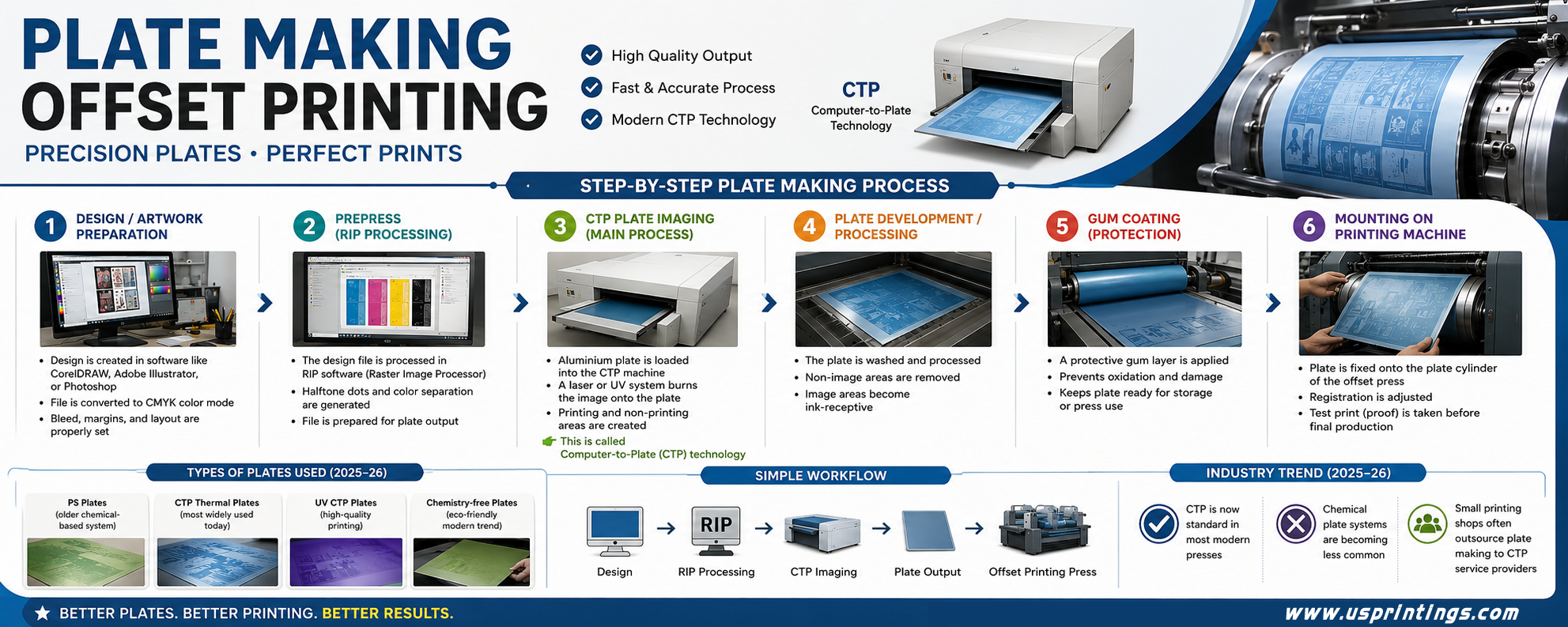
🧾 Step-by-Step Plate Making Process
1. Design / Artwork Preparation
- Design is created in software like CorelDRAW, Adobe Illustrator, or Photoshop
- File is converted to CMYK color mode
- Bleed, margins, and layout are properly set
2. Prepress (RIP Processing)
- The design file is processed in RIP software (Raster Image Processor)
- Halftone dots and color separation are generated
- File is prepared for plate output
3. CTP Plate Imaging (Main Process)
- Aluminium plate is loaded into the CTP machine
- A laser or UV system burns the image onto the plate
- Printing and non-printing areas are created
👉 This is called Computer-to-Plate (CTP) technology
4. Plate Development / Processing
- The plate is washed and processed
- Non-image areas are removed
- Image areas become ink-receptive
5. Gum Coating (Protection)
- A protective gum layer is applied
- Prevents oxidation and damage
- Keeps plate ready for storage or press use
6. Mounting on Printing Machine
- Plate is fixed onto the plate cylinder of the offset press
- Registration is adjusted
- Test print (proof) is taken before final production
🏭 Types of Plates Used
- PS Plates (older chemical-based system)
- CTP Thermal Plates (most widely used today)
- UV CTP Plates (high-quality printing)
- Chemistry-free Plates (eco-friendly modern trend)
⚡ Simple Workflow
Design → RIP → CTP Machine → Plate Output → Offset Printing Press
📌 Industry Trend
- CTP is now standard in most modern presses
- Chemical plate systems are becoming less common
- Small printing shops often outsource plate making to CTP service providers
